


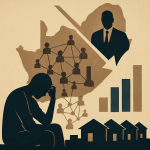
South Africa’s demographic shifts are no longer abstract. Fertility rates are falling, rural areas are depopulating, and emigration — particularly among white South Africans — is accelerating. Analysts warn that these trends could destabilize the country’s economic base, strain social services, and erode intergenerational continuity. Institutions like the Robert H. Smith School of Business and Synthorum argue that population decline threatens productivity, weakens pension systems, and undermines national planning. In this view, demographic contraction is not just a statistical concern — it’s a civic emergency. To ignore it is to risk designing policies for a population that no longer exists, while failing to address the relational and economic conditions that make reproduction feel untenable.
The effects of population decline are uneven across South Africa’s racial groups. According to Stats SA’s 2025 mid-year estimates, the white population is the only demographic experiencing consistent decline — driven by emigration, aging, and a rising crude death rate. Whites now make up just 7.1% of the population, down from 8% in 2020. Meanwhile, the black African population continues to grow, bolstered by both natural increase and regional migration, with over 900,000 black Africans expected to enter the country by 2026. The Indian/Asian population is also rising, while the coloured population sees modest growth. These shifts reflect not only demographic trends but also divergent experiences of civic trust, economic opportunity, and symbolic belonging — each shaping how different groups relate to the future of the nation.
Yet others caution against turning population decline into a moral panic. Publications like Jacobin and Empty Planet argue that demographic contraction is a natural recalibration — a response to urbanization, autonomy, and ecological limits. They critique pronatalist alarmism for masking deeper issues like economic inequality, gendered labor expectations, and cultural alienation. In South Africa, where unemployment and civic betrayal run deep, the refusal to reproduce may be less a crisis than a symbolic protest. It reflects a population unwilling to offer its future to a system that feels extractive and incoherent. From this angle, the real issue isn’t fewer births — it’s the absence of a society worth reproducing into.
As the author of this post, rikTextual stands firmly with the opposing view — that South Africa’s population decline is not simply a demographic anomaly, but a symbolic withdrawal from a system that no longer commands relational trust or spiritual legitimacy. We do not interpret falling birth rates as a failure of civic duty, but as a refusal to reproduce into incoherence. This refusal is not passive — it is a protest, a ritual withholding of future life from structures that feel extractive, disjointed, and unworthy of continuation.
This position is scaffolded by two of our recent commentary posts. “Fractal Deflection: Scapegoating Illegal Foreigners to Escape Cultural Accountability” examines how South African discourse ritualizes blame, deflecting attention from internal cultural dysfunctions by projecting crisis outward. Meanwhile, “Fractal Corruption: How African Culture Breeds Political Collapse” explores how familial and symbolic authority structures — when left unexamined — scale into political incoherence. Neither post offers easy answers, but both illuminate the symbolic logic behind civic withdrawal: when the relational and cultural foundations of a society are compromised, reproduction becomes not just difficult, but undesirable.
The reasons South Africans are choosing to have fewer children are not scattered or incidental — they cohere into two symbolic patterns. The first is ‘structural incoherence’, which encompasses economic constraints, career prioritization, and delayed life milestones. Put simply, structural incoherence means the basic setup of adult life — jobs, housing, relationships — no longer fits together in a way that makes sense. The structure is there, but it’s out of sync. These aren’t separate pressures; they’re symptoms of a system that no longer scaffolds adulthood in a way that makes reproduction viable. When housing is unaffordable, employment is precarious, and the transition into stable partnership or parenthood is indefinitely deferred, the act of having children becomes structurally irrational. This is not merely a logistical failure — it is a civic one. And it echoes the argument made in Fractal Deflection, where the state’s inability to foster internal coherence is masked by ritualized blame. Just as foreigners are scapegoated to avoid confronting cultural dysfunction, pronatalist panic distracts from the fact that the system itself no longer supports generational continuity.
The second pattern is ‘symbolic withdrawal’, which includes concerns about the state of the world, mental health and trauma, gendered labor expectations, infertility, relationship instability, and cultural alienation. Symbolic withdrawal is when people step back from society not just because life is hard, but because the deeper meaning feels broken. It’s a refusal that speaks — a way of saying, “This world doesn’t feel safe, true, or worth reproducing into.” These are not just personal hesitations — they are symbolic refusals. They reflect a population unwilling to reproduce into a society that feels spiritually bankrupt, relationally incoherent, and civically untrustworthy. This mirrors the thesis of Fractal Corruption, which traces political collapse to unexamined familial and cultural authority structures. When relational truth is suppressed and symbolic clarity is absent, reproduction becomes not just undesirable but morally fraught. Citizens begin to withhold their future — not out of selfishness, but out of discernment. They sense that to reproduce into dysfunction is to extend harm, not hope.
South Africa’s population decline isn’t just about stats: plugging productivity holes — it’s a deeper signal. People aren’t having fewer kids because they’re indifferent. They’re stepping back. Withholding future life from systems that feel broken, disconnected, and spiritually off-course. It’s not apathy — it’s discernment. And it’s asking us to look closer. The Fractal Divinity series is built for exactly that kind of looking. Across three books, it walks through the cracks in our political, economic, and spiritual lives — not to shame or fix, but to help us see clearly and start rebuilding from the inside out:
- Vote for Yourself: You Are Tomorrow’s Politician
Cuts through the noise of party politics and inherited struggle stories. It’s about reclaiming your voice, seeing land reform as more than policy — as a mirror of unresolved trauma and a chance to choose differently. - The Golden Egg: A Worker’s Resolve
Zooms in on the workplace — how jobs often reflect deeper patterns of exploitation. It’s a call to recognize your worth, not just as a worker, but as someone whose labor carries symbolic weight. - You Know Not God
Gets personal. It looks at how trauma reshapes our idea of God — turning the divine into something distant or punishing. And it offers a way back to spiritual clarity, emotional honesty, and real connection.
- And now, the fourth volume — The God-Form
Moves from critique to construction. It lays down a spiritual and relational blueprint for rebuilding society from the heart outward. It calls men and women to reinhabit their sacred roles, restore mutual accountability, and embody structured love. The God-form is not just an idea — it’s a living antidote to the parasitic Devil-form. It’s the architecture of coherence made manifest through relationship, responsibility, and truth.
These books aren’t just commentary — they’re tools. If this post has stirred something, it’s because the issues it names aren’t just national — they’re personal. And the way forward starts there.
South Africa’s population decline isn’t just a demographic trend — it’s a symbolic protest against civic incoherence and spiritual dislocation. As birth rates fall and emigration rises, the refusal to reproduce reveals a deeper truth: people are withholding their future from systems that no longer feel worthy of continuation.





No Comment! Be the first one.