

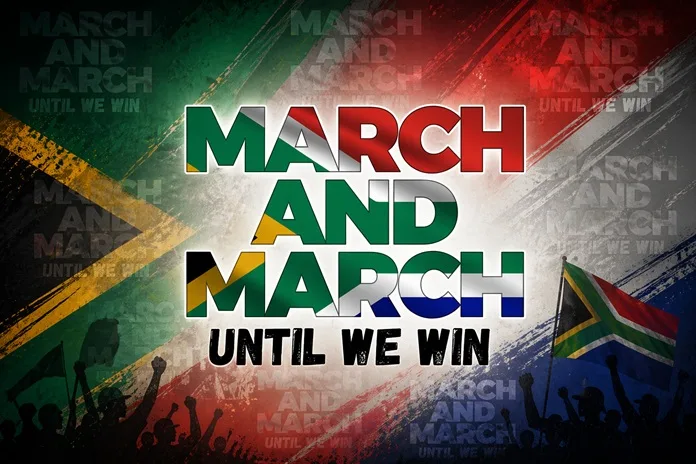
South Africa’s immigration debate has become a stage on which deeper national fractures play themselves out, and nowhere is this more visible than in the rise of March & March: a movement founded in March 2025 by Jacinta Ngobese‑Zuma, who presents her organisation as a citizen‑led corrective to government failure. Its rhetoric promises lawful activism, community protection, and a vision of national renewal, yet its methods and ambitions reveal something far more complex: a self‑appointed force attempting to occupy portions of the state’s authority without a democratic mandate. In this tension between stated purpose and actual behaviour lies the real story of the movement, and the real question facing the country.
March & March’s rise must be understood not only as a reaction to immigration‑related frustrations, but as a symptom of a deeper relational breakdown within South African society. The movement’s appeal rests on a widespread sense of abandonment: citizens feeling unheard, unprotected, and unsupported by a state that has failed to enforce its own laws; yet the movement’s response to this failure is not democratic renewal but the creation of a parallel authority that mimics state power without possessing its legitimacy. In stepping into the vacuum left by government, it does not strengthen constitutional order; it competes with it, blurring the line between civic activism and proto‑governance in ways that expose the country’s fractured political consciousness.
What March & March has tapped into is not merely frustration with undocumented immigration, but a deeper collapse in the relational fabric of the nation; a breakdown in how communities see themselves, how citizens relate to one another, and how the public understands its own democratic power. Instead of mobilising this frustration toward constitutional mechanisms such as voting, public participation, or institutional reform, the movement channels it into street‑level confrontation, creating the illusion of empowerment while bypassing the very systems designed to translate citizen concerns into lawful governance. In doing so, it reinforces the same relational dysfunction that produced the vacuum it claims to fill, turning public anger into a tool for its own political ascent rather than a catalyst for democratic renewal.
The movement’s claim to grassroots legitimacy collapses further when examined against the social divisions it has intensified. Rather than uniting citizens around shared democratic mechanisms, March & March has deepened fractures between the employed and unemployed, the educated and uneducated, and even among ethnic and provincial identities. The movement’s claim to provide civic education becomes increasingly tenuous when examined against the actual form its “educational” efforts take. In practice, its rallies are its only educational platform, functioning as one‑way speeches rather than structured learning environments; mass gatherings where frustration is voiced but little constitutional or policy literacy is imparted.
While the organization itself has not formally rejected expert input, many of its supporters have openly ridiculed analysts and dismissed informed commentary, revealing a culture in which emotional mobilisation substitutes for comprehension. This dynamic exposes a deeper problem: the movement’s educational promise rests on a foundation of limited literacy and little political awareness, leaving its supporters energized but not empowered, and reinforcing the very relational and cognitive failures that prevent citizens from using the democratic mechanisms already available to them.
At the centre of March & March’s political ambition is a vision for South Africa that appears inclusive on the surface but collapses under scrutiny. By positioning itself as the embodiment of “citizen concerns,” the movement effectively claims the right to shape national policy without ever competing in an election or submitting itself to democratic processes. Its leaders present themselves as guardians of sovereignty and fairness, yet their political ambition is revealed not through imitation of past actors but through their attempt to insert themselves into the machinery of governance without ever subjecting themselves to electoral contestation. Unlike smaller political parties that have historically sought influence through formal channels, March & March relies on the visibility generated by its supporters’ confrontational actions to position itself as an indispensable interpreter of citizen will. In this way, the movement’s vision is less a blueprint for national renewal and more an attempt to insert itself into the machinery of governance, bypassing the constitutional pathways that exist precisely to prevent such self‑appointed authority.
The movement’s insistence on “policy reform” further reveals the conceptual confusion at the heart of its activism. The reforms it demands already exist within South Africa’s legislative framework; what is lacking is enforcement, not policy. Yet instead of directing citizens toward the constitutional mechanisms designed to correct enforcement failure: electoral participation, institutional pressure, or civic litigation, the movement channels public frustration into confrontational action that bypasses these avenues entirely. This redirection exposes a deeper societal problem: a populace that has not meaningfully used the tools available to it, constrained by long‑standing relational, psychological, and spiritual dysfunctions that weaken collective agency.
What the rise of March & March ultimately reveals is not simply a failure of immigration enforcement, nor even a failure of political leadership, but a failure in the relational foundations of South African society. A populace shaped by anxiety‑based insecurity, by childhoods marked by inconsistent authority, by adult lives marked by institutional unreliability, and by a political culture in which leadership is experienced as both distant and decisive, becomes uniquely vulnerable to movements that promise protection while demanding obedience. In this landscape, March & March does not persuade through policy or constitutional literacy; it persuades through the emotional logic of insecurity, offering the illusion of safety to citizens whose relational histories have taught them to depend on strong, visible authority for a sense of stability.
This vulnerability becomes the movement’s leverage. By positioning itself as the interpreter of citizen fear, it converts relational fragility into political capital, using the public’s dependence on leadership to advance ambitions that serve the organisation more than the nation. The movement’s ascent is therefore not evidence of democratic renewal but of democratic exposure: a reminder that when citizens are shaped by anxiety rather than agency, they become susceptible to actors who frame personal prosperity as public salvation. In this way, March & March is not merely a response to state failure; it is a symptom of the deeper relational disorder that allows misdirection to masquerade as leadership, and emotional insecurity to be weaponised as a pathway to power.





No Comment! Be the first one.